-->
Showing posts with label ACKS. Show all posts

Friday, October 30, 2020

Cross System Conversions

     I like mixing and matching between multiple systems, genres and milieus, as my various random encounter tables will show.  One of the things I have somewhere is a sheet of paper detailing my cross system AC conversions.  But I can't find it so I'm going to rebuild it with a little help.

     My basic approach for conversions has been to use armor description as the starting point, if you know what chainmail is in AD&D and Runequest, then you can figure out the rest of the armor classes from there.  And since monsters are rated on the same scale as humans (at least for all the systems I can think of); the process is to look at the table I just derived and assign the appropriate AC.

    THAC0, %to hit, attack roll - whatever you want to call is more subjective for me.  Usually, I'll look for a comparable monster in the system I'm converting to and peg the attack roll to the comparable.   Take for example, the 'Great Kommata', a gigantic Martian flying beast from Space 1889: it has two attacks Talons and Drop (rocks).  Comparable is a Roc from AD&D, two 3-18 attacks at 18HD.  Add in a rock attack like a stone giant throwing, but can only hit one character.  Presto, all I need to run a combat encounter with one.

     Converting to Chivalry & Sorcery is a bit different, as I all have to do is select the appropriately sized attack form, say 'MLB' or Monster Large Bite and it gives me the attack rolls against every armor class.  

     Magic is either a spell for spell translation to the target system or I need to define the effect in the target system.  For example, "Crumble Wall" in Warhammer FRP is  similar effects to "Transmute Rock to Mud", the stone dissolves into sand instead of collapsing into mud.  The description is different, but the effect and therefore the level is really the same. 

    This shouldn't be a surprise to the grognards, system conversion has been around since at least the AD&D DMG, right there starting on page 113 where they give conversions for Boot Hill and Gamma World to AD&D (The text mentions both Metamorphosis Alpha and Gamma World, even though Jame Ward wrote both, they use different armor scales).

   What I didn't realize until I was looking the the C&S Saurians book, which I was sure I'd reviewed last year, but haven't, is this little gem.


     Look at that conversion from D&D and Runequest to C&S.  Of course, the Runequest conversion is handwaving the difference between bronze and iron armor in RQ (iron is 1.5x as strong); so I'd take it with a grain of salt.  Still it's a good reason to rebuild my AC conversion table that I've misplaced.


Description   From AD&D  C&S ACKS WFRP MA GWRQ
Banded Plate ACKS, C&S, AD&D 4 4 5 1 4 4 5
Brigantine / Brigandine C&S, RQ7 3 3 1 5 7 5
Chain Mail ACKS, AD&D 5 5 4 1 4 6 5
Chain Mail Hauberk C&S 4 7 5 1 4 5 5
Chain Mail Shirt C&S, WFRP, RQ 5 5 4 1 4 6 5
Chain Mail Shirt & Plate Cuirass C&S 2 9 6 1 3 6 5
Cuirbolli RQ 8 2 2 0/1 7 8 3
Cured Hide MA, GW 7 3 3 0/1 5 6 3
Duralloy Shield MA +4 +4 +4 +1 1 +4 16
Energized Armor GW -4 15 14 3 -6 2 14
Full Carapace MA, GW 5 5 4 1 3 4 5
Full Plate C&S 1 10 7 1 2 4 6
Furs or SkinsGW 8 1 1 0/1 7 8 2
Hardened Leather Cuirass C&S 8 1 2 0/1 7 8 2
Heavy Furs or Skins MA 8 1 1 0/1 7 8 2
Heavy Scale Armor RQ 6 4 3 1 5 7 5
Heavy Shield C&S +1 +2 +1 +1 6 +1 12
Hide & Fur ArmorACKS8 1 1 0/1 7 8 2
Inertial Armor GW -4 15 14 3 -6 2 14
Lamellar Armor ACKS 4 4 5 1 4 4 5
Leather Armor ACKS, AD&D 8 1 2 0/1 7 8 2
Leather Jack/ Jerkin WFRP 8 1 2 0/1 7 8 2
Light Scale Armor RQ 6 4 3 1 5 7 4
Light Shield C&S +1 +1 +1 +1 6 +1 8
Linen Armor RQ 8 1 2 0/1 7 8 2
Mail Coat & Hose C&S, WFRP 4 7 5 1 4 5 5
None AD&D 10 0 0 0 8 10 0
Padded Armor AD&D 8 1 2 0/1 7 8 2
Partial Carapace MA, GW 7 3 3 1 6 6 5
Piece Metal Armor GW 5 5 4 1 3 4 6
Plant Fiber Armor MA, GW 7 3 3 0/1 5 6 4
Plastic Armor GW 0 11 9 3 -2 3 10
Plate Armor ACKS, AD&D, RQ 2 9 6 1 2 3 6
Plate Cuirass C&S, WFRP 3 6 5 1 4 5 6
Power Scout Armor GW -4 15 14 3 -6 2 14
Powered Alloy Armor GW -4 15 14 3 -6 2 14
Powered Assault Armor GW -8 19 18 4 -10 1 18
Powered Attack Armor GW -8 19 18 4 -10 1 18
Powered Battle Armor GW -4 15 14 3 -6 2 14
Powered Plate Armor GW 0 11 9 3 -2 3 10
Ring Mail ACKS, AD&D 7 3 3 1 5 7 4
Scale Mail ACKS, C&S, AD&D 64 3 1 5 7 4
Shield ACKS, AD&D, WFRP, GW +1 +1 +1 +1 6 +1 12
Shield of Non-metallic Substance MA +1 +1 +1 +1 6 +1 8
Soft Leather C&S, RQ9 1 1 0/1 7 9 1
Splint Armor C&S, AD&D 4 3 3 1 5 4 4
Studded Leather AD&D 7 3 3 1 6 7 5
Superior Chain Mail C&S 4 8 5 1 4 5 5
Thin Metal Armor MA 5 5 4 1 3 5 4
None AD&D 10 0 0 0 8 0 8
ACKS - Adventurer, Conqueror, King:  Ascending armor class
AD&D - Advanced Dungeons & Dragons: Descending Armor Class 
C&S - Chivalry & Sorcery: Ascending Armor Class
GW - Gamma World: Descending Armor Class
MA - Metamorphosis Alpha: Descending Armor Class, starts at 8
RQ - Runequest: Armor absorbs damage rather than setting the target to hit.  Also the armor can vary by body part, i.e. you can wear a plate cuirass and have only soft leather on you legs.  Note, I hand waved the difference the system makes between bronze and iron armor.
WFRP - Warhammer Fantasy Role Playing: Armor absorbs damage rather than setting the target to hit.  Also, the armor only protects certain body parts. Leather is rated 0/1, as it only absorbs damage from blows where the damage is <=3.  If the damage is 4 or greater, all of the damage affects the character.

Converting RQ and WFRP armor to other systems, I'll use the highest value provided. 
 

Thursday, October 22, 2020

Feudal Wilderlands: Severnais Random Encounters

   The final aid I'll develop for adventuring in the Severnais is a set of random encounter tables.  As before, I'm pulling in creatures from pretty much every game in my library to give encounters that sense of whimsy I enjoy.  


     I should also note that I have a set of Random Encounter Generation home rules that are consulted before I get to these tables.  Over the years I've moved from most of my random encounters being combat and experience point oriented to designing a system that will generate information for the players about the area.  What I have below are tables of challenges they may encounter, or they may just see evidence of and start looking over their shoulders for the monster to appear.

     Encounter areas follow natural ecosystem and movement boundaries.  Looking at the map of the Sverenais, I determined that there are four encounter areas.

     North Dearthwood  The area of the forest north of river flowing out of the Dearthwood into the Roglaroon and the tributary of the Conqueror's River as well as the Conqueror's river upstream from there.  Looking at the Wilderlands of High Fantasy booklet, there are three "Lurid Lairs" listed in the area for Wood Nypmphs, Pixies and Hippogriffs.  From that I have determined that I will use the "Fairy or Sylvan" table in AD&D and the "Elf Wood" table in Runequest when generating the appropriate encounters.  I also ended up with two encounters from Call of Cthulhu in that area, so I've decided that the entire area is subject to planar instability, where 'nexus points' to use the Empire of the Petal Throne terminology naturally appear and enable all sorts of beings to enter the Wilderlands.

     Victory Hills  Not a canonical name, but what I'm calling the hills where the Conqueror's River rises.  They extend up to the River Stillring, most of them are outside of the Severnais proper, so I can re-use them as an area when I detail the heartlands around the City State itself.

     North of Severn  and South of Severn The Severn provides a natural barrier to movement dividing the encounter areas.

     Note that I'm leaving the actual boundaries of the encounter areas rather vague.  These are all or almost all mobile creatures that can have overlapping ranges.  Also, I can roll the encounter and if there's a reasonably close boundary, decide which challenge I want the party to encounter. 

About half the challenge encounters are from AD&D and I expect are familiar to most readers, the source of others are indicated below.

Roll North Dearthwood Victory Hills North of Severn South of Severn
1 Elf War Party (RQ) Humanoid #4 (MA) Centisteed (GW) Snake Python
2 Chimera    NPC Party    Halfling Changer (MA)
3 Al'mi-raj (FF) Giant Skunk Orc Ankheg
4 Wood Nymphs
Lair Hex 2818 (5)
Apparition (FF) Gnome Wild Dogs
Lair Hex 3515 (18)
5 Star Spawn of Cthulhu (CoC) Sphinx (ACKS)    Wild Horses
Lair Hex 3311 (12)
Amoeba (WFRP)
6 Men, BanditWeretiger (ACKS)    Patrol Men, Merchant
7 Bearoid (MA) Giant Ant Merchants (EPT) Arn (GW)
8 Patrol Wild Boar Fire Lizards
Lair Hex 3011 (3)
Hawk (normal)
9 Cthonians (CoC) Leprechaun Yexil (GW) Buzzers (MA)
10 Needlemen (FF) Patrol Llama (Dreamlands) Rust Monster
11 Elf Chénlh (EPT) Men, Brigands Wolves
12 Sprite Stirge Kobold Cockatrice
13 Troll Giant Stag Beetle Basilisk Throgrin (ACKS)
14 Hippogriffs
Lair Hex 3318 (2)
Men, Berserker Goblin Demon, Artificer (Infernum)
15 Pineto (GW) Men, Dervish Elf Giant Centipedes
Lair Hex 3612 (10)
16 Harpy Elf Url-worm (Dreamlands) Sun Worm (WFRP)
17 Cockatrice Men, Brigand Men, Bandit Rakox (GW)
18 Pixies
Lair Hex 3017 (40)
Dark Fungus (MA) Men, Merchant Patrol
19 Su-monster Rényu (EPT) Giant Toads
Lair Hex 311 (11)
Men, Merchant
20 Giant Stag Hlýss (EPT) Small Warrior (MA)  Wolves
(ACKS) Adventurer Conqueror King,    (CoC) Call of Cthulhu,    (Dreamlands) H.P Lovecraft's Dreamlands, a CoC Supplement,    (EPT) Empire of the Petal Throne,    (FF) Fiend Folio,    (GW) Gamma World,    (Infernum) Mongoose's Infernum - Role Playing in Hell,    (MA) Metamorphosis Alpha,    (WFRP)  Warhammer Fantasy Role Playing

(#) - A number in parentheses indicates the number encountered in the lair.  All are from The WIlderlands of High Fantasy.

Creature notes:
Al'mi-raj (Fiend Folio) - Chaotic unicorn bunny

Amoeba (Warhammer FRP) - converted this one to Chivalry & Sorcery earlier

Apparition (Fiend Folio) - ethereal skeleton, can cause heart attacks

Arn (Gamma World) - a 1.3 meter bug that can be used as a riding mount by very small humanoids

Bearoid (Metamorphosis Alpha) - 12' tall golden psionic golden bear.  Uses bows and clubs.

Buzzers (Metamorphosis Alpha) - mutated bees that can blast a party with pure energy.  Enraged by psionics and magic use.

Centisteed (Gamma World) - 16 legged horse that can carry two.  Comes equipped with a force field.  No cupholders.

Change (Metamorphosis Alpha) - mutated robin with chameleon powers.  No attacks, immune to spells and psionics (too bird-brained).

Chnélh (Empire of the Petal Throne) - ape mutants.  Sharp claws and teeth.  Use spears and clubs.  Treat as cavemen, but look like Australopithecus 

Cthonian (Call of Cthulhu) - immense thing squidly worms.  Can crush with their bodies, constrict and drain blood with their tentacles.  Oh, they can cause earthquakes too. 

Dark Fungus (Metamorphosis Alpha) - psionic fungus brain.  Don't touch

Demon, Artificer (Infernum) - a squat little demon, one of the Engineers of Hell.  This one can understand and fix mechanical devices on a roll of 5+; has +3 natural armor and weeps poison tears that it uses to coat it weapons.

Elf War Party (Runequest) - 1d6 brown elves (look like deciduous trees) armed with bows and swords (bronze) .  They have a decided resemblence to the local trees, oaks, chestnuts, laurel and pine, with bark like skin, interweaving bracnhes for hair and knobby fingers like twigs.  They will be neutral or hostile to halflings and humans; friendly or neutral to 'meat elves' and down right aggressive to other races.

Hawk (normal) (Adventurer Conqueror King) - just a normal small raptor.  If a character can plausibly attract it, it can be trained to hunt small game.  Otherwise, 50% chance it attacks a wizard's familiar.

Hlýss (Empire of the Petal Throne) - six legs and a chitinous shell.  FIght with weapons and a sting, ofetn have jewels set in their shell.  Collect humans, probably for hosts for their eggs.

Humanoid #4 (Metamorphosis Alpha) - Walks on all fours, has poison claws, low intelligence.

Llama (H.P Lovecraft's Dreamlands) - all the possible monstrosities and I roll a normal llama.  Treat as a pony that climbs like a goat

Merchants (Empire of the Petal Throne) - 3 merchants, 8 guards, 23 slave bearers with merchandise.  Merchants and guards have elaborate chlen-hide armor (treat as scale mail, but less cumbersome) and weapons (have 5% chance of being broken if parried by iron/steel weapons).  They have exotic glass wear and chlen hide armor for sale - preferably will trade for iron.  The leader has an "Eye of Abominable Detestation" (treat as double strength wand of fear) and an "Eye of Incomparable Understanding" (treat as area effect Comprehend Languages spell).

Needlemen (Fiend Folio) - humanoid zombie plant.  Shoots needles at you

Patrol (Chivalry & Sorcery) - one knight, a squire and two sergeants from a local fortress.  In the Dearthwood, 75% chance that it is instead 1d4+2 Duneal foresters (treat as rangers) or elves.

Pineto (Gamma World) - ambulatory plant that can carry heavy loads.  Can be ridden, but without the proper saddle, you take damage every turn.

Rakox (Gamma World) - oxen with eight horns and a carapace.  

Rényu (Empire of the Petal Throne) - Humanoid dogs.  Can speak and use weapons, can't use magic.  Can be captured and trained, exceedingly loyal servants.  Detect secret doors like elves.

Small Warrior (Metamorphosis Alpha) - mutated ants with a mass mind that can generate a force field

Sphinx (Adventurer Conqueror King) - I called this out to remind myself to check for the differences between sphinxes in ACKS vs AD&D.  Turns out you can generate a random encounter with a sphinx in ACKS, but there is no entry in the Monster section for it.  Treat as a Criosphinx. - 

Star Spawn of Cthulhu (Call of Cthulhu) - miniature, but still gigantic copies of Great Cthulhu, 60 feet tall.  Tentacles claws to match their size.  Use magic and cause insanity.

Su-monster (AD&D) - forty years of gaming, never encountered one of these or added it to one of my adventures.  Cross between an ape and an opossum with psionic attacks.

Sun Worm (Warhammer FRP)  Shjockingly, a 6' maggot that discharges electricity.  Double damage if you're wearing metal armor. 

Throgrin (Adventurer Conqueror King) - looks like a hobgoblin, paralyzes like a ghoul, regenerates as a troll.  Nasty little buggers.

Url-worm (H.P Lovecraft's Dreamlands) - man sized worms that feed off oils secreted by the dhole.  Used by the halflings of D'haz for unspeakable practices.

Weretiger  (Adventurer Conqueror King)  - treat as AD&D weretiger, with they are naturally stealthy and have a -2 on surprise checks

Yexil (Gamma World) - big (3 meter long with 8 meter wing span) orange furred mammal.  Shoot frickin' laser beams from it's eyes.

Sunday, October 18, 2020

Feudal Wilderlands Part VII - Elves


   As I mentioned in an aside in my notes on towns, I needed to think through the role of elves and by extension other non-humans in the Wilderlands setting.  In Map 1 alone there are seven Elven settlements, five of which are ruled by men, conversely there's a single human settlement ruled by an elf.  Halflings, orcs, goblins live in settlements ruled by men; only gnolls seem to always have independent communities.  Despite Thunderhold being a Dwarven kingdom, according to the Wilderlands canon, it's actually a human settlement.

   That presents an appearance of dominant humanity, which coincides nicely with this non-canon deep history of the Wilderlands.  I was remembering this vaguely as I sat down to write, but it took going through the all canonical sources I've accumulated (originals, reprints, Rob Conley's revisions and some of the 3rd edition release)  and determining that it wasn't in them before I searched the internet and found the post again.  But none of them really give me a sense for how elven society is structured.

     Going back to the sources - Tolkien is the spring from which all of these flow.  He describes the Noldor (High Elves) in terms of nobility and kings, the Wood Elves of Mirkwood follow the same pattern.  But this isn't the same as the human patterns of settlement; he shows them in great cities like Gondolin, vast fortress caverns, Menegroth and the Caverns of Thrainduil that involuntarily hosted Bilbo on his journey; great halls like Rivendell and even isolated smithies as Eöl the Dark Elf labored in.  Except for the last, these are all communities with at least dozens if not thousands of individuals living in them.  In contrast to the human and hobbit lands where agricultural references are made in describing the scenery; elves do not appear to cultivate fields. (I searched every reference to Gondolin in the Silmarillion, and never once are fields mentioned, nor can I recall Rivendell or Lothlorien being mentioned as having fields.)  From this, and the persistent association of elves and forest, I deduce that the elvish diet is heavy on fruit and nuts, perhaps including some grains like wild rice that grow in water.   Given the longevity of elves, the thought of them tending large plantations of fruit and nut trees for centuries makes sense.  Even the mortal elves of AD&D can expect to raise several "crops" of oak trees in their life times, and dozens of plantings of fruit trees.  Nor do they appear to raise animals for food or clothing, game is probably the commonest form of meat.  The plantations of oak trees provide an attractive forage for wild pigs; fruit trees do the same for deer - providing an alternative agricultural cycle that humans would view as "natural", just as American settlers didn't realize the relationship between Native American's setting fires, the prairie and buffalo.  It still takes more land per calorie than grain and vegetables, so  they must usually live in relatively small groups, dozens to a few hundreds.  Gondolin and Vale of Tumladen must have been both extensive in size and exceptionally fertile.

     This tracks pretty well with the game systems.  AD&D has 20-200 male elves in an encounter, with 100% females and 5% children in lair.  Warhammer Fantasy Role Playing has 10d10 Wood Elves in a settlement.  (Noble elves tend to be lynched for their arrogance when travelling human lands.) ACKS has restrictions on where you can create a Fastness, but otherwise the same as humans for developing domains. when creating Elven Domains I'd reduce the size of the urban areas by considering them Agrarian with a Dispersed Settlement pattern, which would make the largest Elven city 5000-10,000 in population.  Chivalry & Sorcery doesn't really address Elvish realms, although they use human social patterns, less serfs.

     Runequest of course is non-Tolkien with elves being living, sentient plants bound at leats looslely to their forests.

     So, got a bit off track there, but it's useful to work through these elements when deciding how I'll run them in the Feudal Wilderlands.

     1.  I will not increase the size of Elven settlements the way I did with human settlements.

     2. I can describe the settlements now as being in the midst of groves of oak, chestnut and walnut with little undergrowth around the settlement.

     3. While the senior elven leader in the area is considered a 'king' and subordinates are styled 'dukes'; it's really humans trying to fit elvish concepts into a human framework.  Much like the Romans always referred to German 'kings', when chieftain or war leader was probably a more accurate description of the position.

     4.  Somewhat analogous to the Ottoman millet, Elves live in the boundaries of the feudal nation, but are not strictly of it.  They have their own leaders and laws, who judges depends on the offense, where it occurred and the social status of the offender and victim.  In other words, it can be a mess leading to grievances (multi-generational on the part of humans) depending on political influence.  Of course, if your a commoner - no one cares that the elves tattooed your face with blue and red stripes before they escorted you to their borders and told you to never return.

Previous Posts in this Series

Monday, October 12, 2020

Feudal Wilderlands VI - Notes on Towns and Villages

When I was writing the previous post, I fully intended to increase the size of the settlements and add settlements to the area.  The Wilderlands always having seemed rather sparsely populated, especially as I'm using  Chivalry & Sorcery 1e to build the Feudal Nation.  That system says a county, like Severnais, should have 1-6 towns and the minimum town size is 1500.  That's 1500 total adults, as opposed to the numbers given for fiefs in the core rules which are in fighting men, or at least for those capable of bearing arms, no matter how untrained they were.  I deduced this from the central section on Chivalric army organization, maintenance an combat that precedes the Individual Combat section.  It's easy to tell what Backhaus considered more important, it also is a reflection of the hobby's roots in tabletop war gaming - Chainmail anyone? 

     So I totaled up the population figures I had determined for each fief and came out with a rural population total of around 37,400 (The C&S Sourcebook gives population totals for each size fief, in addition to the number of men capable of bearing arms.)  I divided that number by five to get the number of families; for the divisor I used the multiplication factor ACKS uses to go from families to totals - giving me 7,480 families.  Afterwards I found a note I had forgotten on the key to the Towns table in C&S - "Population = number of adult citizens; 20% are fit for military service." (Note to self:this is interesting as it refers to citizens, not inhabitants.  Medieval and classical civilizations made bright distinctions between citizens and non-citizens, so depending on the city you could have large numbers of non-citizen inhabitants.  See for example Constantinople and it's Genoese exclave.  Maybe a topic for another post.)  Which aligns the two rules systems rather well for calculating urban populations.

     And that lead me to look at ACKS domain building rules.  By default they assume 90% of the population are rural; 37,400/0.9 = 41,555.  Rounding to the nearest 100, I'll call it 41, 600 for an urban population of 4,200.

Canonically the following villages exist in Severnais

Name              Pop     Inhabitants     Hex

Tain                  404     Men               2814

Thoth                177     Men               2711

Elf-burn            144     Elf                 3213

Limerick          150     Men                3313  

Boughrune       230     Men                3412

Adderwood      312     Elf                  3117

That's 1,417 urban inhabitants total; but based on the way I'm envisioning the Feudal Wilderlands, the elves don't count as they have their own social and political organizations that parallel and overlap with the humans.  So now we're down to 961 human urban inhabitants, for a deficit of essentially 3,200.

    I can increase the population of existing villages, none of which even one third the size of a C&S town, or create new towns, or mix and match.  Of course, I'll mix and match.

    A new town, Stanbeach, population 2000 in hex 3013 provides a port on the River Severn in the the middle of the county.  Tain, the Count's capital becomes a large town, and each of the other human settlements are about doubled in size.  Adding in the ACKS Market & Urban definitions as I may end up playing with the whole trade rules when characters dispose of loot.   I'm not touching the elvish settlements as I haven't quite thought through how I want to handle them.

Name              Pop     Inhabitants     Hex          ACKS Market           ACKS City

Stanbeach       2000     Men              3013              Class IV               Small City

Tain                 1050     Men              2814              Class IV              Large Town

Thoth                360     Men               2711             Class V                Large Village

Elf-burn           144      Elf                 3213

Limerick          330     Men                3313              Class V               Large Village  

Boughrune       410     Men                3412              Class V               Large Village

Adderwood      312     Elf                  3117


Edits: Fixed the name on the map, added new castles and keeps to map and added links to post

Saturday, May 9, 2020

Wilderlands - So how big IS a Barony?

     In my last post, I had graphically demonstrated that there was no room for nomads in Altanis, based on the patrol area of "Baronies" as listed in the canon.

     In this it follows closely with the OD&D booklet Volume 3 The Underworld and Wilderness Adventures which, in lieu of a number of hexes, gives a patrol radius.

     By time we get to AD&D, the term "Baronies" has been changed in the DMG to "Territory Development by Player Characters".  
DMG page 93

     Honestly, I find the rules opaque, the DM gives the player a map of 6 hexes, the scale isn't stated but I assume it's 30 mile campaign hexes.  Then (start) map(ping) the hexes at a 200 yard scale, so they fit nine into a one mile hex.  Once the player has mapped the central hex and six surrounding it - this is the confusing bit - which scale is he talking about, 200 yard, 1 mile or 30 miles?  It will take a LONG time to randomly roll enough 200 yard hexes to map seven 30 mile hexes.  In any case, to get back to how far the character will patrol, I interpret the final paragraph to mean once the character has cleared a thirty mile campaign hex, wandering monster checks are reduced.

     I'm going to add in one more system at this point, Adventurer, Conqueror, King includes domain level play in it's core rules and defines the territories, not only of Baron, but of a number of greater nobles also.


Time for some math!

    The Wilderlands definition of patrolling out four hexes from the center hex creates and area of no less than 61 five mile hexes.  Each file mile hex is an area of 21.65 square miles, so the area of a "Barony" in the Wilderlands is 1320 square miles or 845,216 acres or 342,047 hectares.
     OD&D defines a Barony as patrolling a twenty mile radius,   1256 square miles, or 803,840 acres or 325,303 hectares.
   AD&D is opaque, but I'm going to assume he meant a barony equaled a 30 mile campaign hex or 779 square miles or 498,831 acres, or 201,870 hectares.
    ACKS comes in a a puny six mile hex.  That give it an area of 31 square miles,  or 19,953 acres or 8,075 hectares.

Lets put it in a table and do some real world size comparisons.
Region Description Square Miles Acres Hectares
San Marino Fifth smallest country 2015.36 6216
ACKS1 x Six mile hex 3119,953 8,075
Liechtenstein Sixth smallest country 6239,680 1658
Rutland 40th largest Ceremonial County 15297,500 39,457
Sao Tome and Principe 25th smallest country 386247,040 99,974
Westmoreland 29th largest Ceremonial County 759485,990 196,637
AD&D 1 x Thirty mile Campaign hex 779498,831 201,870
Mauritius 26th smallest country 788504,320 204,091
Rhode Island Smallest US state 1033661,120 267,546
Samoa 29th smallest country 1097702,080 284,122
Gloucestershire 17th largest Ceremonial County 1235790,470 319,892
OD&D Twenty mile radius circle 1256803,840 325,303
Wilderlands 61 x Five mile hexes 1321845,216 342,047
Cornwall 16th largest Ceremonial County 1336854,770 345,913
Cabo Verde 30th smallest country 1557996,480 403,262
Delaware Second smallest US state 19381,240,320 501,940


     In Real World terms,  the areas given for Wilderlands, OD&D and AD&D are simply too big, they are the size of an English County.  Now, I know that Ceremonial Counties do not represent a contiguous landholding, but while their size and boundaries have wavered over time, they do go back to the Norman Conquest where they are used as census units for the Domesday Book.  And that book shows that several barons will have holdings within the County.
    One illustration of the practical issues with the sizes given is the time it would take to patrol areas this large.  For a Wilderlands barony, it would take a single patrol over two months, at twenty miles a day, to pass through every single square mile.   Keeping monsters out of such a large area would be a frustrating game of Whack-a-Mindflayer, even with multiple patrols.

More Math Ahead!

    As long as we've reached this point, what is a reasonable size for a Barony, or any other feudal demesne?  Does ACKS have it right at a about 30 square miles?
    To answer that question, I'm going to pull out my go to system for world-building for the last 40 years - Chivalry and Sorcery.  The old red book provides a system for Designing the Feudal Nation, allowing you to generate the demesnes of the great lords, down to the landed knight.  Who isn't terribly humble even if his small manor house isn't much more impressive than the local inn.
   In this system Barons are the lowest nobles (knights being of "gentle" birth rather than "noble") however, unlike the Dukes, Earls and Counts above them, they are NEVER 'tenants-in-chief' holding their lands directly from the King.  Instead, they report up to one of the great nobles - and their fief is generated as part of generating the demesne and feudal holdings of their overlord.  In short, if when generating the fief holders of the great noble, you randomly generate a small castle or shell keep, you create a barony to hold it.  The barony itself will have fief holders dependent on it, but these will be mere landed knights.

    In the C&S Sourcebook, under Feudal Economics, are rules for calculating the amount of land to grow food for a given population.  There is a page of text, but it comes down to add up the population figures from the table, multiply by 10 to include families, beggars and bandits in the area.  This gives the total population, which is multiplied by 8 to determine the number of acres of cultivated and pasture land required to support the population.

   There is one more source I'm going to pull in, Leonard Cantor's The English Medieval Landscape.  This tome, published four years after the Sourcebook, reviews land use at the time of the Domesday Survey.  It shows that "35% of England was covered in arable land, 25% put to pasture, with 15% covered by woodlands and the remaining 25% predominantly being moorland, fens and heaths."  
     Note that the percentage of crop land to pasturage is reversed from the Sourcebook, but it's the ratios of those together to the total amount of land that I'm interested in obtaining - and that ratio is 6 acres of farm and pasture to 4 acres of wood and wasteland.  I can now calculate the average size of a "Barony".

     In doing so, I am assuming that each Barony will have the same breakdown of land use as the kingdom as a whole.  That is of course, another spherical cow of uniform density - a working approximation that meets my current level of detail.
     So, throwing the C&S tables into a spreadsheet and letting it do the math for me, based on the possible outcomes of the determining the Baron's tenants, I find that a Barony will hold between 56 and 118 square miles of territory, on our five mile hex map that is between 3 and 6 hexes (rounding up to the nearest whole hex).  Because of the distribution of possible out comes, the average size is 81 square miles or 4 hexes.  Now I can re-do the last map.

Altanis Baronies & Villages
Click to enlarge
Now, I have room for Barbarians!

Thursday, April 23, 2020

Wilderlands - Give Me a Home, Where the Barbarians Roam

Barbarian Altanis are nomadic tribesmen who roam the lands of their more advanced ancestors.  Initial Guidelines Booklet I.

     After laying out the CSIO Market Area and boundaries, looking at the number of villages, castles and citadels on Map 2, I developed a strong impression that there isn't sufficient unclaimed areas to support tribes of nomads.   Rob Conley, in his revision of Wilderlands, assures us that there is plenty of room to fit the nomads in.  Let's see for ourselves.

 
Altanis Village Market Areas
Click for full size
     The first step is to layout the Market Areas for all of the villages on Campaign Map 2.  Technically, they are all Market Class VI in ACKS with a twenty five mile maximum.  (That would only come into effect if the village was located on a road, which only one is, so almost all borders have been shortened using the MP costs from the previous post. )  But Antil is less than seventy inhabitants below the cut off for Market Class V, they exist in a strategic position for shipping on the Romilian Sea - and I was bored with the small areas, so I used the larger area for it.

As can be seen in the Altanis Village Market Area map there is very little area outside the Market Area (the multicolored lines and shaded areas) of some village or another. And I haven't even looked at Barony patrol areas yet.

    Thinking over the image, I decided that it is unrealistic to assume that every hex in the Market
Altanis Village Neighborhoods
Click to enlarge
Area is under continuous occupation or observation by the villages; which would preclude or at least discourage nomads from wandering through.  I decided to reduce the footprint of the villages to their immediate neighborhood, where the fields and pastures worked on a daily basis would be found.  The outer areas are analogous to what Warhammer Fantasy Roleplay refers to as 'Zones of Dependency' where isolated farmsteads, mining claims and natural resources, such a salt licks are to be found.  [Note:  Settlement patterns in WFRP's 'Old World' setting are nothing like Wilderlands, but concept of scattered holdings around the village makes sense.]    This produced the Altanis Village Neighborhood map, where the blue lines show the area surrounding each village that is under daily use.  

Plenty of room for nomads now!  OK, I need to add in the areas patrolled around the castles and citadels, as I don't see a feudal knight allowing a bunch of barbarians to chase a herd of mammoths through his serf's wheat fields.

Per the original Wilderlands of High Fantasy

BARONIES

Upon building a stronghold, player-characters must clear every four hexes (five miles each) radiating from the hex in which his stronghold is located.  While clear terrain can be maintained monster free by patrols, mountains, swamps and dense wood hexes cannot be maintained clear of monsters.  For this reason barons do not usually patrol these areas, prefering [sic] the more tillable clear terrain and hilly areas.

Altanis Villages and Patrolled Areas
Click to enlarge
In this case, I did not reduce the patrolled area by terrain costs, but I did end the patrolled areas at the terrain features listed.  For the most part, as there are a couple of citadels smack in the middle of jungle hexes that would be patrolling something.  In counting off the hexes from each citadel, I have come to suspect that there was some effort made in placing them, as the patrol areas for neighboring citadels usually abut or overlap by no more than a hex.  Rather than laying out these overlapping areas, I chose to map the continuous areas patrolled by the citadels with it.  That brings us to the red lines and shading on Altanis Villages and Patrolled Areas.


Other than the Eyestone Jungle on the east coast, there isn't much that isn't patrolled.  The Lagoldurna Jungle to the east has a string of villages cutting it in half restricting the range of any nomad tribes.

    So, there's no room for nomads in Altanis.  Well, not if you assume a feudal society around the strongholds.  In my next post, I'll cover putting the barbarians back in Barbarian Altanis along with some notes on the barbarian nations to be encountered at the players peril.

Sunday, April 12, 2020

WIlderlands Land Trade Radius and Political Boundaries

        Wilderlands - Land Trade Radius
I started out doing an analysis of land trade routes to determine economic spheres of influence.  I quickly ended up doing political boundaries.  The two are certainly linked in the real world, however I don't provide a segue between them so this post is a bit disjointed.

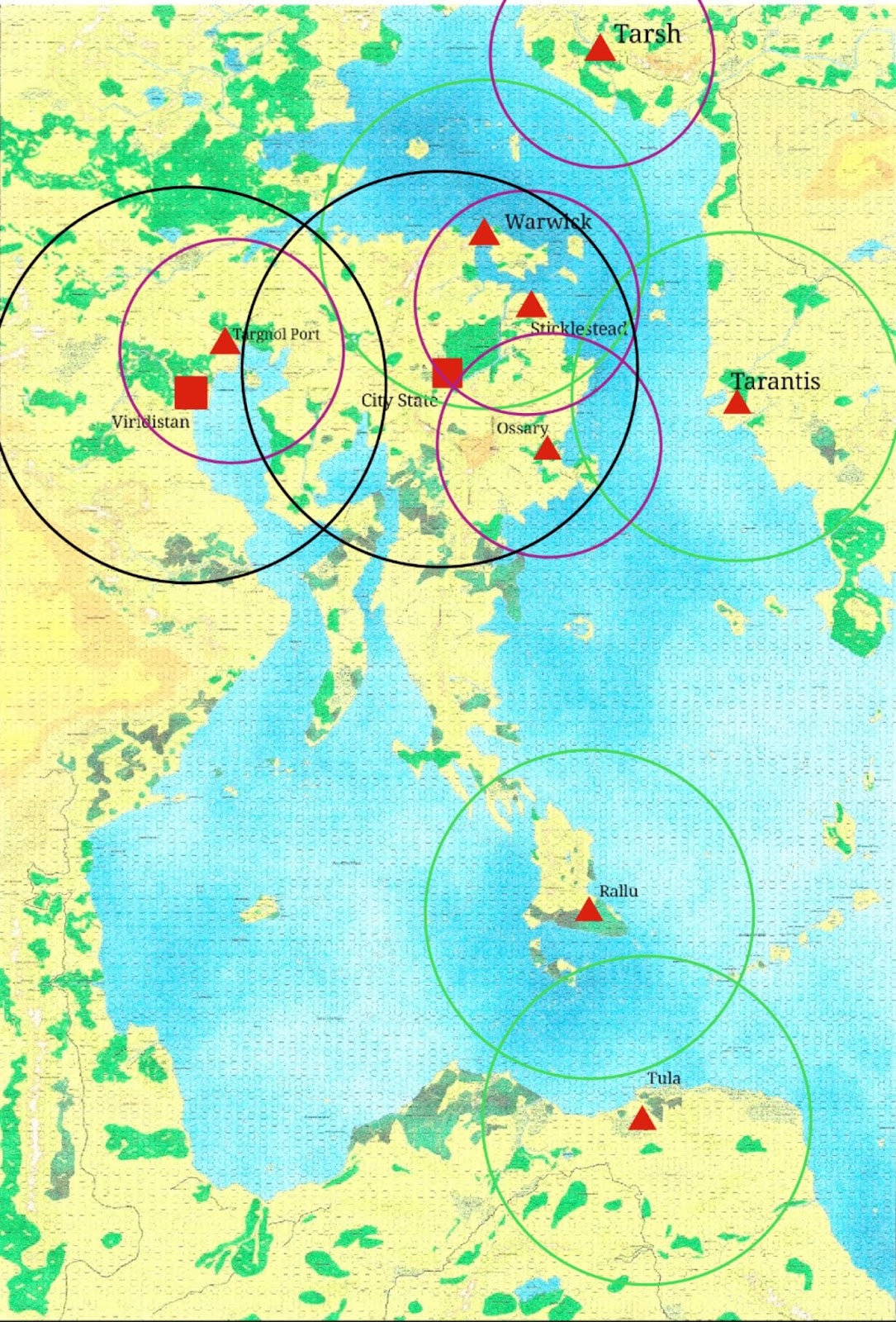
In the first diagram I have entered the locations of the largest settlements and drawn the radius of land trade routes for each.  The radius comes form the Adventurer,Conqueror, King rules -AFAIK, the only system to tackle trade in a systemic way.  Shown are every settlement with over 2500 inhabitants - there's only ten.

The circles represent the approximate maximum distance of trade via a road from the settlement.

Black circles are the largest, they show the trade radius for Class I Markets [Population >= 20,000], limited to Viridistan (City State of the World Emperor) in the west and the City State of the Invincible Overlord in the center.

Green circles show the land trade radius of Class II Markets [Population >= 5,000]: Tarantis in the east, Warwick north of the City State, Rallu and Tula in the south.

Purple circles surround Class III Markets [Population >= 2,500]: Tarsh in the north, Targnol Port in the west and Sticklestead and Ossary east of the City State.

For a bidirectional trade route to have a chance to exist, the circles need to contain both settlements.  See for example Targnol Port and Viridistan.  If only one of the circles contains both cities, then no trade route exists, see the City State and Ossary.  

We have only four potential land trade routes, Viridistand/Targnol Port; City State/Warwick; City State; Sticklestead and Warwick/Sticklestead.

More about this in later posts.

Drilling into the the area of the City State and Viridistan, which is the only area where city states are close enough to have mutual boundaries, I come up with this diagram.  Besides the land trade radius, I have now added political boundaries.
Wilderlands Political Boundaries

Viridistan and the City State are the big dogs of the continent, as such, the smaller city states - especially Warwick, have been quite constrained in their boundaries.  Despite Warwick being the only Class II Market on this map, it actually controls less land area than any of the Class III Markets.  The Rorystone Road and the Dwarven Kingdom of Thunderhold, long an ally of the City State keeps it from expanding west of Demon Tongue or south of the River Stillring.  Port Targnol is a wholly own subsidiary of the Green Emperor in Viridistan.  Probably ruled by the descendants of a former royal house, as canonically there isn't anyone left but the Emperor and Empress in the current royal house - he was extraordinarily thorough in removing potential rivals. 

The reddish area in the middle, Battleplain Gwalion, shows the conflicting claims between the two city states.   The City State claims west to the River Bucknol and Grimlon Outlands, then south through the Buskin Wood to the Romillion Sea.  Conversely, the Emperor asserts his claims all the way east to Ered Cantrif, then south to the River Wakeful from the Falls of Barzani to it's mouth.  In practice the Overlord maintains a line of fortresses from Keystone Peak to Lakenheath on the northern edge of the plains and Viridistan rarely pushes patrols east of the Crossing of Quoth, although tax collectors from both sides plague the villagers in the disputed area. 

Further posts will cover actual trade routes, including laying out additional roads; sea trade; and thoughts on the social structures of the Wilderlands.