-->

Friday, March 8, 2019

Fascinating but flawed.


Anyone doing a historical political or trading game should have this in ther Appendix N.


   A well written account of the foreign trade of the Roman Empire through Egypt and the Red Sea. It explores the products associated with it's trading partners, the difficulties merchants faced in obtaining these products and the internal and external taxation policies effecting foreign trade.
While concentrating on the goods obtained from East Africa, the Arabian Peninsula and the Indian subcontinent, it book also includes valuable information on balm from Judea, the Nile to Red Sea caravan route supporting the Indian Ocean trade and the Roman trade goods sent to the east.
   Well organized, the book starts with tables of common abbreviations, comparisons of Greek, Egyptian, and Roman currencies and estimate of Roman government expenditures, especially the costs of maintaining the legions. He follows this up with an enlightening description of the various trade routes before moving into chapters discussing the trade with the individual regions and countries. He relies mostly on Pliny and the Periplus of Erythean Sea for these areas, but adds insights from a number of modern secondary sources, as well as nuggets of information and colorful illustrations from other sources from antiquity, such as Martial, Philostratus and Strabo. The book ends with a brief discussion of the Antonin embassy to China, the authors conclusions and appendices showing the author's economic calculations.
   His overall thesis is that many of the Roman provinces, such as Gaul and Britania did not produce enough tax revenue to support the legions stationed within their bounds. That these local shortfalls were made up by taxation on foreign trade. That the foreign trade was imbalanced in that Rome was exporting bullion acquired from previous conquests and mining in exchange for luxury consumables and that the foreign trade collapsed due to running out of bullion and this in turn caused the collapse of or significantly contributed to the collapse of the Empire.
   McLaughlin is a gifted author who writes in a clear, engaging style. He takes what could easily be a dry scholarly dissertation and creates a readable narrative, supported by copious footnotes. I find that his conclusion, while plausible, is not convincing for a number of reasons.
   First is a stylistic reason concerning his footnotes. There are many, but he only uses the an abbreviation of the name of the work, never including the edition nor in the case of sources from Antiquity, the translation if he used them. This makes researching his footnotes a matter of deduction and selecting an edition and translation. For example, the very first footnote is simply Res Gesta, 15. I can infer that he means the funeral inscription of the Emperor Augustus - Res Gesta Div Augusti, as opposed to the Res Gestae of Ammianus Marcellinus or other such works. I used the translation available at the Internet Classics Archive (http://classics.mit.edu/Augustus/deeds.html).
   While this might seem minor, his whole conclusion rests on the statement “Pliny confirms over 100 million sesterces of Roman bullion was exported from the Empire every year.” The footnote supporting that statement reads Pliny 12.41. Now, we can infer that by Pliny, McLaughlin means Pliny the Elder Natural History as the likely reference. Looking up editions we find that Henry T Riley's translation (H. G. Bohn, 1855) is available at www.perseus.tufts.edu and Philomon Holland's 1601 translation (Desfontaines, Paris, 1829) is available at penelope.uchicago.edu . Holland's translation can not be the source of the assertion, as he does not have 41 chapters in Book 12. Now in Riley's translation we find Pliny writes “At the very lowest computation, India, the Seres, and the Arabian Peninsula, withdraw from our empire one hundred millions of sesterces every year “, looking for a similar statement in Holland's translation we find Book 12, Chapter 18 “ India, the Seres, and that demy-Iland of Arabia, standeth us at the least in an hundred millions of Sesterces, and so much fetch they from us in good money“. This one does mention money, which would have included bullion in it's composition, but what is the original Latin text? From bibleotheca Augusta (www.hs-augsburg.de) we find : “minimaque computatione miliens centena milia sestertium annis omnibus India et Seres et paeninsula illa imperio nostro adimunt” Which tracks with Riley's translation much better than Holland's.
   “Sesterium” referring to money would indicate the large brass coins worth ¼ of a silver Denarius or 1/100 of a gold Aureus. However it's most common use in Latin literature is as a unit of accounting, indicating value. As brass is not an alloy of precious metals, then assuming it to refer to the coin itself would not support McLaughlin's conclusion. As a unit of accounting, we then need to determine if goods other than silver and gold coins were exported from Rome. And the author helpfully supplies us with multiple references to the export of red coral, wool and grain to India. Thi conclusively disproves the author's interpolation of bullion into Pliny's statement. While gold and silver coins, particularly the high quality early imperial coins were used for commerce, we are unable to demonstrate the proportion of the trade value they accounted for. Therefore, we can nly conclude that McLaughlin's contention is plausible, not certain.
   One other flaw, that contributes to taking a close look at his conclusion is his unquestioning use of the legendary Syracusia as an example of the technology available and used by Roman merchant ships. Our source for information about the Syracusa is Athenaeus of Naucratis text Deipnosophistae (http://www.attalus.org/old/athenaeus5b.html#c40) – also known as the world's first cookbook. It recounts a series of tales told at banquets; in the case of the Syracusia or Hieron's ship; it is told third hand repeating a tale told by a man named Moschion.
   Now the Deipnosophistae was written in the early third century AD and Hieron lived in the early third century BC; so any information has passed down generations before it was written down. What caught my attention was the description of a device called a raven “ iron ravens, as they were called, all round the ship, which, being shot forth by engines, seized on the vessels of the enemy, and brought them round so as to expose them to blows “; I immediately recognized the term and knew it to be wrong. For the raven or corvus was a Roman invention from the Punic Wars described clearly by Polybius as a hinged gangplank with a spike on the end that was dropped on enemy ships in order to facilitate boarding by Roman infantry. Quite sensible in galley based sea battles – completely useless as a defense against pirates as McLaughlin postulates. The last thing a merchant wants to do is attach his vessel with a pirate ship full of armed men. I then started looking at the description of the ship itself and started laughing at the idea of towers with rocks and weights to drop down on other ships, as well as gardens and tile roofed pavilions on the deck – for so much weight above the waterline will raise reduce the stability of the vessel and increase the risk of capsizing. As happened with the Vasa in 1628. The ship was said to have been built in two sections which were launched separately – unlikely but possible. I served on the USS Tarawa (LHA-1) which was constructed in that manner and had a step in the middle of the passageway where the builder had misaligned the decks. Having been launched separately, by necessity it would have needed to be moored somewhere while the halves were joined, yet Athenaeus goes on to relate that the ship was too large for an harbor in Sicily so it was given to Ptolomey in Egypt. I've seen two estimates for the size of the ship 55 or 110 meters; I've also driven an Anchorage class LSD (169 meters) into Syracuse. The Grand Harbor although less sheltered than the little harbor, has always been of ample size. The more sheltered little harbor is still almost 500 meters from it's base to the current breakwater. Such uncritical acceptance by the author detracts from the work.
   I've pointed out the flaws in the book, but it's still a worthwhile read for anyone interested in the Roman Empire and I recommend it as a launching point into the sources so the reader can draw their own conclusions.

Monday, February 18, 2019

Review – Beneath Kra'adumek by Venger As'Nas Satanis


     Kra'adumek is a preview of Venger's upcoming Cha'alt kickstarter. He offered it as a free download a couple of weeks ago and I grabbed it off DriveThru.
     A small dungeon, consisting of 17 separate encounter areas, it's full of unique monsters and Venger's trademark weirdness – with hardly any sleaze.
     He provides a quick overview of the Cha'alt background and Kra'dumek in particular, including Magical Mishap tables, details the PC's will know, rules for advantage and recommended charcater numbers and levels. The Noteworthy Details section could use some logical organization – it's an ordered list of all of the above. Not a big impact in this product, as it's only one page, but would be difficult to follow if it went on for two or more pages.
     The adventure hook is straight forward, the characters and other citizens have all been mind controlled – in super HypnoToad style – for years. That control has been interrupted, so it's time for some payback. This works well for a one shot and may be the recommended intro to Cha'alt (I don't know). I could see, in an episodic campaign, having the characters come to their senses there with no idea how they arrived. But overall, I would treat it as a one shot if you don't have Cha'alt.
     The encounters are well written, giving the DM plenty of info to extemporize role play when applicable. There are a couple of encounters that will wipe the party out if they go into the wrong place – there's warning of trouble ahead, but hack and slash parties will bull ahead into deadly trouble. Because that's my kind of group, I think I'd modify the hook a bit and have the characters trying to rescue the sacrifices or prisoners in the more 'civilized' area of the dungeon.
     New spells and weapons are well detailed and he has a nifty new (well different from The Isles of Purple Haunted Putrescence) stat block format. But I have to assume he's using an ascending AC system as it's never called out. Of course, I don't really care what the numbers are there, it's been years since I last ran an adventure using the game it was written for. I just convert them to suit.
     Overall, a solid little dungeon. But I'm deducting a skull because it won't be easy to drop into another campaign and the information organization issues.


Monday, October 22, 2018

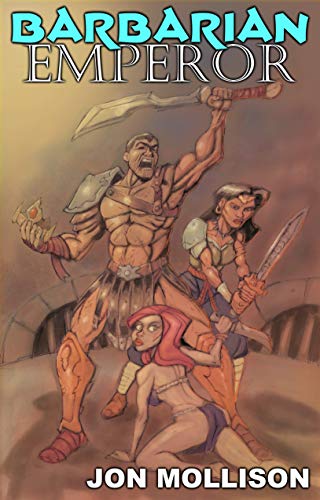
Barbarian Emperor by Jon Mollison

Alexander Macris has been posting some publicity for this volume, so I decided to give it a shot ($2.99 on Kindle), as I have been looking for something new to amuse myself for the last few months.

Superficially, it's another sword and sandal fantasy story, albeit one in an ACKS friendly setting. I bulled through the inauspicious beginning; wherein the old Barsoom trope of the hero being mysteriously translated to another world gets a trotted out. As the new setting is an ersatz-Roman Empire, it was doubly inauspicious to me, as I am extremely well read in the history of the Republic and Empire; not just having read the popular histories and even Mommsen's seminal works, but having dug up writings on demographic patterns, city planning, and Roman religion (pity Varro's books didn't survive outside of Augustine's hatchet job refutation). Since I didn't watch the series, I can't say how much the story was influenced by Spartacus: Blood and Sand; but it certainly has more to do with that than the writings of Polybius or Caesar.

Then the action started, the pace of the story picked up and the author began to weave different threads into a tapestry, every scene advancing the hero's story. The tale became increasingly more enthralling as it moved away from ersatz-Rome to a unique borderland. Pulpy like Robert E. Howard's stories but in a different, self-consistent and suitably mysterious way. Exposition of the characters thought processes provide reasonable rationales for decisions, both good and bad; and almost as importantly are concise, setting up the next action scene. No spending half a book lost in the fens outside of Mordor's front door in this story!

Three plot twists that caught me off guard. One I should have seen coming and one where I completely swallowed the hook. Well played! In the end the hero gets a girl and a crown ... and I found myself wanting to know what happens next. That to me is one of the marks of a good story, when it leaves me hungry to know what's in the next chapter.

I won't give out any spoilers, you can always drop me a line after you've read the book if you want to know what I missed until the end.

Over all, I give it four skulls out of five and recommend you pick it up for a couple of hours of light reading pleasure.

Sunday, July 22, 2018

Interlude in Pavis

I started a RQ Classic campaign recently, with four players who have been
playing mostly a AD&D 1e campaign and an old grognard who primarily
played RQ in college in the early 80s.


For a setting, I'm using Pavis & The Big Rubble.  The characters started
off at Old Fort at the confluence of the Scritha and East Scritha at Sacred
Time of 1610, just after the Lunar occupation begins.


To introduce the newcomers to the system, I started them with answering the
KoDP clan questionnaire, followed by a ‘how the clan survived’ heroquest to
demonstrate how skills are used and advanced and give the players a taste of
how spiritual as well as physical quests mix in Glorantha.  
In the Great Darkness the Brothers left the village to search for food.
First Brother came to a barren field, from it he heard voices calling out to him. Digging in the field he found Ernalda's children and brought them back to the village where they grew into crops.
Second Brother came to a cave where a giant lived with his cattle. Second Brother disguised himself as a cow and joined the herd when they went into the cave. When the giant fell asleep, he led the herd out and back to the village.
Third Brother was walking along the stream when he saw a strange girl drowning under the water. He leapt in, swam down and saved her. She taught him how to catch fish.
Fourth Brother found a set of tracks and followed them up a windswept hill. At the top he found an alynx with it's fur matted and ribs showing. He fed it all the food he had, in return it followed him back to the village and kept Ernalda's children free from rats and chaos vermin.
Fifth Brother was lost in the forest, finally he began to climb the largest tree in the wood. He climbed all the way to the top where he beheld the first sunrise. Foolishly, he climbed the sun's rays until he disappeared into the sky.
The heroquest also functioned as a divination for the coming year. Based on their rolls, their village will probably be wiped out by famine.   


A couple of side quests, where I split the group by family relationships, had
most of them tracking down a prize bull that had been stolen by a nomad.  
Even though I gave them all some ability to speak Praxian, no one
understood what he was saying, so it ended in combat. The other character
is a son of a carpetbagger who returned from Tarsh with the Lunars.  He
went out on a patrol with the Marble Phalanx detachment and was introduced
to the Morokanth slavers, baboons, trollkin and herdmen through the
Borderlands Scouting the Area encounter.


Then they set out for Pavis, losing a character in a drinking contest during an
encounter with a Troll caravan.  A quick trip into the Rubble cost another
character half an arm and put most of them in bad odor with the local Mostali.
 They then signed up at a variety of temples for training before we called it a
night.


Overall the new players seemed to enjoy it.  The lethality surprised them, but I
had made a batch of pre-gens so they didn't get bogged down in character
creation.

One thing that went over well was I had grabbed pictures from a number of the
PDFs I've picked up, so I could show them a morokanth, a trollkin or the gate
at Pavis

Friday, January 12, 2018

Thracia - an ACKS Campaign

[Adventure report from a new campaign.]

     Dave [Thief], the somewhat scapegrace second son of the Count of Mount Haemus [comes Haemimontus], accompanied by his bodyguard Corwin [Fighter] and his secretary Goris [Venturer] were sent to retrieve the Rhododendron Amulet by his father.  Along the way the encountered Brother Hendel the Healer [Cleric], who had been dispatched to the same village to investigate reports that the local Temple of Nature's Justice had been taken over by some frog faced cultists calling themselves the Temple of Justice Everywhere. 
     As they approached the village, thunder rumbled regularly in the distance.  Corwin considered that in his experience it was natural, not gunfire.  Nearer, they could see lightening stabbing down ahead.  Whatever was being struck was hidden by a hill and woods on the other side of the village itself.  Interrogating the first yokel they encountered, Dave learned that it was the Lightning Tower down on the coast, and that the it had been this way for decades.  Incredulous that no one had investigated, he pressed the yokel, who responded defensively that they made sure to keep the cattle away from it.

     Getting directions from the yokel, they went down the road to the manor, having decided that Dave's errand would take priority over Brother Hendel's.  Along the way they passed the Temple and had a clear view of the Lightning Tower and of the four iron massive iron spikes around it.
     Walking boldly up to the front door of the manor, they were derailed by the sight of three corpses leaning against the wall.  Approaching cautiously, having heard tales of skeletons and zombies, they determined that one of them was a peddler Brother Hendel had known to sell healing herbs in Hadrianoplis.  They could not determine the cause of death based on inspection.
     Leaving the corpses, they rang the bell, and stayed off balance when they came in and saw that the butler was the ghost of a balrog [ed.  Gotta love these pre-cease and desist lawsuit adventures].  When they questioned him about the corpses outside, he responded that he thought the gardener had already taken care of them, but that he would follow up.  
     The confusion continued when Dave asked for Sir Rankling as directed and the butler asked in response "His picture or his spirit, my lord?"  Choosing the spirit they were given directions to another room.  However a nasty battle with twelve skeletons in the first room they needed to cross room left Brother Hendel and to a lesser extent Corwin, too wounded to continue, so they returned to the village.

     Engaging rooms at the White Horsed Sleigh, they went in search of Arnthora, the dispossessed priestess.  In her pokey little room, crammed with the furnishings she had been able to retrieve at the Temple,  she told Brother Hendel of being forced out by the cultists and that their influence was growing in the village.  She had little to offer on the Lightning Tower and opined that if they could handle the cultists, they could handle anything in the manor.  Whether or not they could handle either was an open question.  She was well aware of Bertalan the butler and didn't seem to see anything amiss, just that the manor had always been that way.  And by the way Sir Rankling was the current owner's great-great-grand uncle and had been dead for some time, but his picture could answer questions about the manor.  She also warned them not to look at the other portraits in the manor. 
     Over supper at the inn, Corwin, Goris & Brother Hendel observed two people enter and sit down with a couple of locals at another table.  The newcomers had green faces and extremely wide mouths.  Inferring that these were some of the cultists, Corwin and Brother Hendel went to get Dave, who was dining in his private room.  Corwin remarking that the green was tattooing.  Before they returned, the other party got up and left.  Goris moved to intercept the locals, pretending that he was here to inquire into some tax irregularities.  This gave him and earful about the ruinous assessments from the mayor and an appointment to meet the next morning to go over the books.

     While the others sold four of the goblets they had recovered at the manor, Goris went over the books and earned contempt for not only failing to find anything; but for not asking for a bribe either.  Brother Hendel passed him on the way out; and tried some very unsubtle intimidation on the mayor.  After a quick meeting with Arnthora, who warned Brother Hendel to leave town after he recounted his visit with the mayor, they went back to the manor - this time choosing to cut across the fields, rather than going close to the Temple.  That idea seemed to work out until they crossed through a narrow woodlot and discovered that the ground was torn up by some large beast.  Sadly, none of them has Tracking proficiency, so they don't know what to be worried about.
     The gardener having apparently disposed of the bodies, they delighted Bertalan by allowing him to take their cloaks.  But he knocked them off guard again when Dave asked how he knew to call Dave 'my lord' and Bertalan responded he had nipped home and looked them up in the Book of the Damned   Deciding this time to try asking Sir Rankling's picture which turned out to be hung right there in the Entry Hall.  Dave led off by asking the picture"How are you doing?"  Which got him a pleasant response, but the picture wouldn't respond to any other question.  Deciding to check another portrait, Dave then fell into a frenzied fit on the floor.
     Questioning Bertalan, they learned that the portrait would only answer one question a day; the skeleton's that they had fought had been guests of Lady Rithiena; and that the Rhododendron Amulet was on a shelf in his bedroom.  He couldn't go fetch it for them, as the werewolves were expecting visitors but he gave them instructions to his room.  Brother Hendel and Goris left Corwin watching the foaming Dave and had a uneventful trip through the manor, taking care not to touch anything else than the amulet itself.
     Beating a hasty retreat back to the village, they passed an quiet night.  Brother Hendel had a final interview with Arnthora and promised to bring help.  he also left her with one of the goblets to sell for funds.
    On the return trip they stumbled across some kobolds in the process of setting up an ambush.  They quickly routed the little dog lizards, leaving three dead and three fleeing.  Goris, mistaking himself for an AD&D monk, had attempted to knock a javelin aside - but caught it through his off hand.  Despite Brother Hendel's quick actions, he ended up losing three fingers.
   After a day of rest in the larger village of Bizye, they spent the trip back to Hadrianopolis debating if giving the Amulet to Dave's dad would set off some sort of arcane apocalypse.  In the end Dave turned it over, winning his father's favor and learning that it was essentially a magic dog whistle that his father had won in a wager with Sir Runic - who in his father's opinion is a first rate poltroon who has abandoned his responsibilities while living in Constantinople. 
     Brother Hendel has been informed that there is no one with the requisite skills available at the Temple to solve Arnthora's problem.  Dave and his staff are being sent back to investigate the Lightning Tower and check the condition of an old Roman fort in the area.  He has however, convinced his father to let him take a horse and some riding mules from the stables.

Monday, April 10, 2017

Fisher River Scouts


Prime Requisite: Dexterity
Requirements: None
Hit Dice: 1d6
Maximum Level: 11

The fisher River Scout is an explorer, hunter and guard of the waterways around the Holt or Raft. Human rulers often hire them, when available, to provide warning of trouble approaching in the water or to bypass enemy land defenses and gather information.

River Scouts are trained combatants, although they strongly prefer to avoid being noticed. At first level they hit an unarmored foe (AC0) with an Attack throw of 10+. They advance in attack throws and saving throws as Thieves, by two points every four levels of experience. Because of their concentration on moving in the water, River Scouts have a narrow selection of weapons and armor. They may wear no armor heavier than leather and may only use weapons from the sword/dagger and bola/darts/nets/slings/sap/staff lists. River Scouts may fight with two weapons, but may not use two handed weapons or shields. River Scouts get no damage bonus and may cleave once per two levels. River scouts have the Blade-Dancing power. The character gains a +1 bonus to Armor Class if wearing leather armor or lighter and able to move freely. At level 7, the AC bonus increases to +2,

A river scout has many stealthy abilities enabling them to avoid detection and gather information. At first level they have the thief abilities of Climb Walls, Find Trap and Move Silently. At second level they add the ability to Remove Traps, at fourth level they can Backstab and at ninth level they add the bard ability to Read Languages.

Additionally, they have the following custom powers available at first level: Difficult to Spot ( The character has the ability to seemingly disappear into woods and underbrush with a proficiency throw of 3+ on 1d20. In dungeons, if the character is motionless and quiet in cover, he can escape detection with a proficiency throw of 14+ on 1d20.) and Tracking. The character can follow tracks with a proficiency throw of 11+. At fifth level they gain the power of Savage Resilience. When the character is required to consult the Mortal Wounds table, the player may roll twice and choose the preferred result to apply. The character also subtracts his class level from the number of days of bed rest required to recover. They have a Swim speed of 90' and the following abilities as Fishers: Paralyzation: 3 times per day when executing a successful Wrestling attack the Fisher may inject a neurotoxin into it's opponent. If the opponent fails to save versus Paralyzation they are paralyzed for 1d10 rounds. If they succeed, the affected body part “falls asleep” for 1d4 rounds.
Electrolocation: The character can locate invisible creatures within 15' in the water or 5' through the air.
Swimming: The character has a swim speed of 90' and can hold it's breath for 30 rounds (5 minutes). at ninth level when they establish a stronghold they gain Animal Friendship. Whenever the character builds a Raft, all ordinary animals within 5 miles of the stronghold become kind and helpful.

Upon attaining 9th Level (River Warden) the River Scout may establish a Raft or village of Fishers. Rafts follow the same rules for population growth as do Elven fastnesses.


River Scout Attack and Saving Throws
Level
Petrif & Paralysis
Poison & Death
Blast & Breath
Staffs & Wands
Spells
Atk Throw
1-2
13+
13+
16+
14+
15+
10+
3-4
12+
12+
15+
13+
14+
9+
5-6
11+
11+
14+
12+
13+
8+
7-8
10+
10+
13+
11+
12+
7+
9-10
9+
9+
12+
10+
11+
6+
11
8+
8+
11+
9+
10+
5+


River Scout Level Progression
Experience
Title
Level
Hit Dice
Backstab
0
River Scout
1
1d6
-
1,175
Water Rider
2
2d6
-
3,550
Swimmer
3
3d6
-
7,100
River Explorer
4
4d6
x2
14,200
River Guide
5
5d6
x2
28,400
River Tracker
6
6d6
x2
56,800
River Pathfinder
7
7d6
x2
113,500
River Ranger
8
8d6
x3
227,000
River Warden
9
9d6
x3
377,000
River Warden, 10th level
10
9d6+2*
x3
527,000
River Warden, 11th level
11
9d6+4*
x3
    * Hit point modifiers to Constitution are ignored
River Scout Skills
Level
Climb Walls
Find Traps
Move Silently
Remove Traps
1
6+
18+
17+
-
2
5+
17+
16+
18+
3
5+
16+
15+
17+
4
4+
15+
14+
16+
5
4+
14+
13+
15+
6
4+
13+
12+
14+
7
3+
11+
10+
13+
8
3+
9+
8+
11+
9
3+
7+
6+
9+
10
3+
5+
4+
7+
11
2+
3+
2+
5+


River Scout Proficiency List: Acrobatics, Alertness, Ambushing, Beast Friendship,Cat Burglary, Climbing, Combat Reflexes, Combat Trickery (disarm, knock down), Eavesdropping, Endurance, Fighting Style, Land Surveying, Lip Reading, Mapping, Mimicry, Naturalism, Navigation, Passing Without Trace, Precise Shooting, Riding, Running, Seafaring, Skirmishing, Skulking, Sniping, Survival, Swashbuckling, Trap Finding, Trapping, Weapon Finesse, Weapon Focus

River Scout Proficiencies Gained per Level
1
2
3
4
5
6
7
8
9
10
11
C+G
-
-
C
G
-
-
C
G
-
-


Wednesday, March 22, 2017

Requiem for a Grognard

We buried Cucch one month ago today.  My sons carried one side of the casket and I gave the eulogy.

Mike Cuccherialla


Sue, I am humbled and grateful that you asked me to speak today, for although it might have surprised my mother to hear it, Mike was my brother. A brother in arms, a brother in spirit and a brother who shared my life.
Father Tim, Sue shared your hobby with me, and you cannot believe how appropriate it is for you to be performing Mike's ceremony,as Dungeons and Dragons was a shared hobby for myself and Mike and for a great many people in this room.

For while I can't tell you exactly when I met Mike the first time; I know that it was soon after I came down to the Twin Cities for college and that it involved playing Dungeons and Dragons. One of the guys in the dorm played and was in Navy ROTC. He introduced me to a group of his friends who were in ROTC and gamed together. Mike was there in the group, ready to have fun or provide whatever help anyone needed. I always remember him with a smile lurking on his face and a look in his eye that no matter what, he was enjoying life.

Well, Mike graduated, got his commission in the Navy and moved to Norfolk. I heard about him occasionally through our friends, but didn't speak with him for about two years, until Karen and I married, I received my commission and we too moved to Norfolk, expecting our first child. Mike was there, same smile and look in his eye; showing us around and helping us move into the apartment below his. He was at the table with us for Thanksgiving; helped us bring the crib home from the store, an episode that saw him play a practical joke on a shipmate that traveled to Italy and back that summer and has stayed with us for over thirty years.

I had a six month deployment to the Mediterranean which started two months before Karen was due. But I didn't worry, because I knew Mike would be there. And when the hurricane blew in, after our son's birth, and they they were talking about evacuating Norfolk and Virginia Beach, Mike was there to tell Karen not to worry, since they hadn't sent the fleet out to sea to avoid the hurricane, there was no need for her to pack up a new born and try to find a place to stay.

Mike left the service and moved back to Minnesota, while I stayed in for a number of years; again I'd hear about him occasionally. But one summer, while we were moving from San Diego to New York City, we stopped back in the Twin Cities and I somehow managed to track him down in those pre-cell phone days. We arranged that he'd come out to my sister-in-law's house where we we staying late in the evening, because of his schedule. And Mike was there, but this time he surprised us with Sue. That's how I got to meet the great love of his life and hear the story of how he had to go all the way to Yugoslavia to meet to meet a nice girl from east of the river.

Our ways parted again, until I left the service and came back here to settle down. And Mike and Sue were there, welcoming us back and inviting me to join with them and their friends officially to play Dungeons and Dragons, but really we spent just as much time socializing, every month or so for most of the last sixteen years.

Soon after, we returned, Mike and Sue told us there was a baby girl overseas that needed a family. And Mike and Sue were there, to bring Katherine into their home, their family and their love; raising a beautiful young woman who takes after her father in the way she holds her head, chooses her words, the love and support she gives her friends and in the joy she takes in life.

When our oldest son,Michael, the one who was born during that first deployment, was married only 18 months ago, Mike was there. Sharing his zest in life, making a speech and dancing with everyone, while wearing the most godawful blonde wig – basking and amplifying the joy felt by our family.

Finally, just six weeks ago, on the coldest day of the winter, Mike was there. To support me and my family at my mothers' funeral, he, Sue and Katherine had driven three hours in sub zero temperatures to be there for us and show us their love and support in our own time of need.


 Mike's legacy and challenge to me and to all of us, is to be there for each other in happiness and sorrow. To remind us that all clouds will pass and to fill our lives with joy.