Friday, December 20, 2013

Book Report - Cthulhu in Wonderland

A Pleasant Little Offering

A. Pleasance Liddell on the sanguinary griddle,
bound to the foetid altar tight

Batrachians romp through the tenebrous swamp,
midst cacophonous Polyps in flight

The byakhee wheel in the Reticulated Reel,
dance to the cultists howling fright

Mad little Alice, in the Crimson Queen's palace,
prey to the author's sad delight.


Cthulhu in Wonderland (The Madness of Alice) by Kent David Kelly
  A retelling of Lewis Carroll's masterpiece in the Cthulhu Mythos, which as I recall, the original didn't need much in the way of Lovecraftian prose to make it confusingly verbose. (Why is it whenever I read Lovecraft, I mentally hear it being declaimed by William Shatner?) This love(craft) child of Carroll and the Master mixes both vocabularies freely and without concern for meaning or comprehension by the reader.  It is, as said in Blazing Saddles, 'authentic gibberish', a fun read but only once.

It didn't give me any inspirations for gaming, but it did inspire me to write the doggerel above.


Sunday, December 15, 2013

New Campaign and Mini-Recap

     We started a new campaign this month, and for my sins, I'm back behind the screen. I've taken advantage of my time off to look at how I run the games and decided to make some major changes. Previously I've tried to ensure I had all of the answers to any question my players might ask - down to writing a door generator that told me which side had the hinges. Perhaps my wife is right and I am a bit of a control freak - just a little.

     The campaign concept has been influenced by the soloplay I did (much) earlier this year, using the Mythic game system.  I liked the directed randomness, an odd term but the best way I have to describe it. I also realized that I never have time to do all the preparation I would like before its time to run the adventure, so I need to use modules in addition to anything I create.  Thirdly, I'd like to bring in things from different systems. Many of the bloggers did a post on their gaming bookshelves, showing them overloaded with systems. I'm no different, other than many of mine residing in electronic  format rather than paper.  And the last constraint is that the group is using Pathfinder, so all the mechanics would need to be D20.

     I decided, since I have most of the Warhammer Death on the Reik adventures,  I would use the WFRP setting.  It's much different from the group's standard fantasy setting, in that it has elements of horror and firearms. I'm using the Mythic Fate Chart and Chaos Factor make the setting more 'alive', instead of my usual pre-scripted effort.  And as time goes on I'll bring in monsters and artifacts from other settings.

    I'll do a full recap of the initial session and some lessons learned, but here's the short form.  I found what may be the most awesome published adventure ever in The Nine Virtues of Magnus the Pious, (WFRP 2?) where the characters start in a city in the middle of being sacked - and the situation goes downhill from there.  After taking damage from friendly cannon fire and being chased through town by mutant Mongels, they reached the climactic fight scene on the roof of the City Hall between the thief who had suckered them into helping retrieve the MacGuffin for her and her partner who was double crossing her.  All was going well, too well, they had taken out the doublecrosser who ordered the crew of the balloon to leave as he sank back dying.  The Dwarven Magus decided those guys weren't going to get away and jumped a Flaming Sphere into the basket of the balloon. Neatly destroying the only way for the party to get out of town.

     My initial reaction was to declare a TPK, as I had previously decided that the balloon was filled with hydrogen. However the players convinced me that the Hindenburg would be a better model of the physics of a hydrogen fire than David Weber.  They then chased the survivors into a Chaos Zone, eventually into the local Cathedral of Sigfreid (patron deity of the Empire).  Now at this point, they were so far off the map and out of the adventure script that I had no idea of what they would find or how I would get them out of the city. Especially as the mutants were starting their final assault on the defenders.

  I used the concepts of Mythic and crowd sourced it.  I asked the players what they thought they'd find when they opened the door of the Cathedral.  They decided that they would find the balloonists stuck right at the door.  That was a bit self-serving of them, so I altered the scene to they found the balloonists whirling around and slowly rising out of sight in the middle of the dome.

Grimoires


Authoritative books on magic are extremely rare, although many are known of, such as the Libram of Silver Magic, Nine Books of Nagash and the Necronomicon, in a pre-Gutenburg world they are almost never actually seen.  The books which are found are almost exclusively what are known as 'grimoires', often referred to as 'spell books'. The term 'spell book' is a misnomer, as these grimoires do not provide step by step instructions on how to cast a fireball. Rather they are a combination of research notes and personal journal which a wizard accumulates over their professional life.  Often they contain quotes and paraphrases of passages from the authoritative books, written down in whatever order the author encountered them.  Indeed, the contents of the great works are spread almost solely through these notes.

An arcane magic user who finds a grimoire has a resource to last his lifetime. By studying the notes of his predecessor (and copying extracts into his own grimoire), the magic user increases his own knowledge of the theory and Art of magic.  This provides him with insight to cast new spells.  Because this insight is coming from the synthesis of his current knowledge with the contents of the grimoire the spells learned from the same grimoire may be completely different for different magic users and the abilities of the grimoire's author have no bearing on what a reader may learn from the tome.  A chance turn of phrase in the notes of an apprentice may unlock a powerful spell.

Mechanics
The number of spells a character may learn from a grimoire is 1d4 + Intelligence modifier.

For each spell, roll on the following table to determine the spell level.  The player selects the spell they are trying to learn from the list of spells for that level.  If they succeed in the Spellcraft check, they have added their preferred spell to their spells known. If they fail the check, they learn a random spell of that level.  It takes two weeks of study to learn each spell.

Note that the DC is set so that in Pathfinder, a character which has Spellcraft as a class skill, has maximized their ranks in the skill and have the minimum intelligence to cast the spell have a 50/50 chance of learning their preferred spell.  It follows that a character cannot take 10 or 20 on the Spellcraft check, as the check is to see if the grimoire along with their current knowledge enables them to learn the desired spell.

Characters cannot learn spells of a level higher than they can cast.


Die RollSpell LevelSpellcraft DC
01-07SpecialN/A
08-10012
11-28114
29-44217
45-58319
59-70422
71-80524
81-88627
89-94729
95-98832
99-00934

Special: A result of Special indicates that among the entries in the grimoire, the character has found a note about an item or person of interest, such as the true name of a demon; a clue to the powers or location of a legendary artifact; or even a standard treasure map.

Saturday, March 23, 2013

Taxes

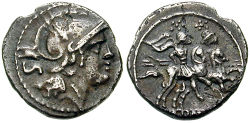
In honor of the fact that I just finished my taxes for the year, and I'm annoyed as I lost my last child deduction because he has a job, not because he's financially independent.  Here's a table of taxes and fees based on those exacted in classical Rome.
Sesterius.  The standard Roman accounting SP at 10 SP to 1 GP
1. The tithes paid to the state by those who occupied the ager publicus. This amounted to 1/10th of the produce or one fifth of the wine and olives

2. The sums paid by those who kept their cattle on the public pastures. The amount was not recorded, but was apparently lucaive, so charge the higher rate - one fifth of the increase in any herd pastured on public land.

3. The harbour duties raised upon imported and exported commodities. One twentieth the value of the goods, including slaves.

4. The revenue derived from the salt-works. One denarius (a large silver piece worth four regular silver pieces (sesterius)) per 60 pecks (524 liters)

5. The revenues derived from the mines (metalla). This branch of the public revenue cannot have been very productive until the Romans had become the masters of foreign countries. Until that time the mines of Italy appear to have been worked, but this was forbidden by the senate after the conquest of foreign lands (Plin. H. N. XXXIII.4,º XXXVII.13). The mines of conquered countries were treated like the salinae, that is, they were partly left to individuals, companies, or towns on condition of a certain rent being paid (Plin. H. N. XXXIV.1; Cic. Philip. II.19), or they were worked for the direct account of the state, or were farmed by the publicani. In the last case, however, it appears always to have been fixed by the lex censoria how many labourers or slaves the publicani should be allowed to employ in a particular mine, as otherwise they would have been able to derive the most enormous profits (Plin. H. N. XXXIII.4). Among the most productive mines belonging to the republic we may mention the rich gold-mines near Aquileia (Polyb. XXXIV.10), the gold-mines of Ictimuli near Vercelli, in which 25,000 men were constantly employed (Plin. H. N. XXXIII.4;º Strab. V. p151), and lastly the silver-mines in Spain in the neighbourhood of Carthago Nova, which yielded every day 25,000 drachmas to the Roman aerarium (Polyb. XXXIV.9; cf. Liv. XXXIV.21). Macedonia, Thrace, Illyricum, Africa, Sardinia, and other places also contained very productive mines, from which Rome derived considerable income.

6. The hundredth part of the value of all things which were sold (centesima rerum venalium). This tax was not instituted at Rome until the time of the civil wars; the persons who collected it were called coactores
For slaves it was charged at two percent.

7. The vicesima hereditatium et manumissionum.  Freeing a slave costs the owner one twentieth of the slaves value as a tax.  A nice one to charge your paladins for doing good deeds.

9. A tax upon bachelors.  Not contributing to the future of the state? Five percent every census, for unmarried men, excluding widowers, over the age of twenty five.

10. A door-tax and a pillar tax. These are taxes on palaces or fancy townhouses, two percent for every door, and one percent for each external pillar. [Ed.  Value is calculated based on the total cost of the building.]

11. The octavae. In the time of Caesar all liberti living in Italy and possessing property of 200 sestertia, and above it, had to pay a tax consisting of the eighth part of their property.  The liberti were freed men (former slaves) , but this works as a tax on any novaeu riche, such as successful adventurers.

See Vectigalia for the source of the information.

Friday, March 22, 2013

Soloplay Game Report - Teuta Act II, Scene 1

As they walked down the road towards Oricum, Lucius told them of the bandit lords who had aided the Macedonians in their fight against the Romans twenty years before.  He described the battle at the gorge of the Aoos that had crushed the Macedonian army and how all of their allies had been cut down or captured and sold as slaves.
   "According to the scrolls that old Lysixenos has, they joined the Macedonians after a two day march.  In that sort of terrain it means that they were within twenty miles of the gorge."
  "So you're proposing we tramp down the Ceraunian road to Chaonia?", asked Sumakos.  "If the the Toad is after Teuta, it will be easy for him to send the Phrygian down the road on a horse and overtake us."
  "Possible", admitted Lusicus, "but unless you think we could take ship at Oricum and sail down the coast, which I can't afford, how else can we get there?"
  "I grew up in the Byllian Hills, we just cut through the fields to the East Road to Dimale and then pick up the course of the Apsus, we can follow it through the mountains and come out in Chaonia east of the gorge."1
  With that they swung east and passed through Dimale as the afternoon faded they decided to press on into the Byllion Hills until the light faded.2  The next day they reached the mountains at the head of the valley, Lucius wanted to push on, but Sumakos and Teuta were adamant they they should camp then and start the ardouous trek in the morning.3,4  The next day they began their trip through the mountains, Sumakos estimated that they should reach the valley of eastern Chaonia in no more than a week. 
Red indicates the group's path.  Green is the trail they meant to take.
The following morning the path forked, Sumakos confidently led them up the left hand path into the shadow of the peaks.  Three days Sumakos announced that they had reached the Candovian trail and Clausura was only a few miles to the right.  As the miles walked by and there was no sign of the valley of eastern Chaoinia, much less Clausura, they became less and less certain that they knew where they were.  Sumakos remained confident that they were on the Candovian trail, but did not try to pretend that he knew wher they might be on that trail.  One midnight Lucius arwoke the others at the sound of horses approaching.  Two riders on shaggy beasts rode into the light of the campfire, armed with scimtars.  They gave a loud whistle and the party realized that there were over a dozen of them.  The leader, wearing padded armor, cantered forward and smiled sardonically, "You shouldn't camp right on the trail, you never know who you will meet."
"We're simply travelers, on our way to Clausura.  We have nothing of value."
"Clausura?  You're on the right trail, but you're a week away."
  "A week, that's lnger than our provisions will last, can we purchase some from you?"
"See, you do have something of value, let's see what you have besides your gold.  Unfortunately, we won't be selling."
Later, as the bandit chieftain rode away in Maedus' scale armor, Teuta remarked "I see his point on who you meet on the road."

  Three days later, Maedus woke them up before dawn, saying there's something out there.  They're mvoing pretty stealthily."  Suddinely, the party was rushed by three goblins, who closed into attack.  Maedus, Teuta and Lucius all missed their attacks.  Sumakos cast Entangle and trapped all the goblins.  After dispatching the evil humanoids, they counted up what they had gained, three morning stars and shields and a handful of silver.  "At least we'll have money to buy food, if we find anyone who has any extra."
Two days later, they camped overlooking the valley and ate the last of their provisions.  The next day the marched hungry into the little hamlet of Clausura.  As the sun approached the zenith, they came up the cluster of buildings, the farmer's wife bustled up from where she was working in the garden.
"You lot look footsore and tired."
"Yes, m'am, hungry too.  Our provisions gave out last night.  Could we purchase some food from you?"
"We can talk about that later, I have some beans in a pot.  You can join us, then we'll talk about what you need to go on."
The farmer, Eucheron and his workers soon came in for the meal.  In the discussion over the food, he mentioned that he had seen Bardyllis and his gang riding north the previous week, so he wasn't surprised that they had run afoul of them.  He wasn't aware of any ruins near the farm, but had rarely ventured into the mountains east of the valley.  He did offer to sell Maedus a set of old studded leather, which he claimed he had recovered from a casualty of the battle years before.  In response to a question from Teuta, he replied that there were no healers in the valley, the closest temple being to the west south of the gorge.5
Game notes below the jump.

Wednesday, March 20, 2013

Movie Review - Oz Great and Powerful

Now I go to movies when my better half tells me I'm going to the movies.  Which means that other than LoTR, where I'm already familiar with the story, I usually don't see anything related to gaming.

Oz is simultaneously a prequel, an independent story and a homage to the original Judy Garland Wizard of Oz film.  Starting with the 'cardstock' titles, which I suspect are actually CGI, the movie tries to emulate the look and feel of the films of the 1930's.  The homage  aspect starts at the beginning where the Kansas scenes are filmed in black and white, as in the original.  Oz is the traveling magician, with an assistant name 'Frank', in the 'Baum Brothers Circus'; a nice shout out to the author.  And there is a brief scene where an old flame stops by to announce that 'John Gale' has asked her to marry him, nicely foreshadowing the heroine of it's predecessor.  I'll also say that the city Oz as imagined in this film, seems to give a tip of the hat to Fritz Lang's Metropolis; which I believe carried over to the Disney castle in the credits.

I won't spoil it with too many details, the story revolves around this sideshow magician becoming the Wizard of Oz.  The story itself may be new, I  know that Baum wrote several books set in Oz, but haven't read them.  The scenery resembles that of the original, but with all the powers of CGI behind it.  The witch is wicked, the Munchkins are munchkiny and [spoiler] the flying monkeys are (mostly) baboons.  They do a nice job of not letting the audience see the monsters the wicked witch has unleashed on the poor residents of Oz, which heightens the dramatic tension.  There was one character development that I did not foresee, but which I heartily appreciated. 

Now for the gaming aspect.  After landing in the Oz, he has an encounter with 'river faeries'; these may help roll back the  Tolkien interpretation of the fae as being wonderful enlightened beings.  These are how the fae should be played, they have the sense of humor of an eight year old and they have teeth.

Baum's works are viewed (probably correctly) as geared towards juveniles, so they neglected as a source of inspiration in RPGs.  This should be revisited by DMs, the flower orchestra is a masterful piece background that tells the characters "you're not in Kansas anymore".  I suspect similar pieces exist in his works.

Finally, if you are in a game that has the Mountebank class, James Franco gives a tutorial in how to play the class.

I give Oz Great and Powerful five skulls.  Mind you, Mila Kunis would get a high skull count for looks alone, but her performance demonstrated a range that I did not suspect that she had.


Monday, March 18, 2013

Book Review - The End of the Story

Clark Ashton Smith's The End of the Story is a a chronological compilation of his work, starting from the beginning.  There are three additional volumes in the series, which I plan on covering in due course.  It's impossible to sum up a group of stories only connected by author and date of publication.  The genre jumps from story to story, Averoigne to Hyperborea to Cthulhu to hard sci-fi and the writing quality varies, as one would expect from a beginning writer, harried by multiple editors.

CAS is considered one of the authors of the canon, despite not being explicitly named in Gygax's Appendix N, as he wrote for many of the same publications as, and was a close friend of Lovecraft.

I've linked items I've been inspired to write up from his work below.  I expect more will be added later.  Obviously, I find quite a few ideas in these stories, yet they're not an easy read.  He's one of the few authors who makes me reach for a dictionary - the last one was John Marshall in his The Life of George Washington - because of his extensive and anachronistic vocabulary.

I was tempted to recommend you find a more cohesive work, say his Averoigne stories, but then I realized how much of the inspiration is coming from the other genres he worked in.

[Ed. Forgot to put in the links!]

Treasures
Goddess of the Ebon Moon 
Portal of Eibon

Beasties
Black Rider
Cactus Viper