Wednesday, March 20, 2013

Movie Review - Oz Great and Powerful

Now I go to movies when my better half tells me I'm going to the movies.  Which means that other than LoTR, where I'm already familiar with the story, I usually don't see anything related to gaming.

Oz is simultaneously a prequel, an independent story and a homage to the original Judy Garland Wizard of Oz film.  Starting with the 'cardstock' titles, which I suspect are actually CGI, the movie tries to emulate the look and feel of the films of the 1930's.  The homage  aspect starts at the beginning where the Kansas scenes are filmed in black and white, as in the original.  Oz is the traveling magician, with an assistant name 'Frank', in the 'Baum Brothers Circus'; a nice shout out to the author.  And there is a brief scene where an old flame stops by to announce that 'John Gale' has asked her to marry him, nicely foreshadowing the heroine of it's predecessor.  I'll also say that the city Oz as imagined in this film, seems to give a tip of the hat to Fritz Lang's Metropolis; which I believe carried over to the Disney castle in the credits.

I won't spoil it with too many details, the story revolves around this sideshow magician becoming the Wizard of Oz.  The story itself may be new, I  know that Baum wrote several books set in Oz, but haven't read them.  The scenery resembles that of the original, but with all the powers of CGI behind it.  The witch is wicked, the Munchkins are munchkiny and [spoiler] the flying monkeys are (mostly) baboons.  They do a nice job of not letting the audience see the monsters the wicked witch has unleashed on the poor residents of Oz, which heightens the dramatic tension.  There was one character development that I did not foresee, but which I heartily appreciated. 

Now for the gaming aspect.  After landing in the Oz, he has an encounter with 'river faeries'; these may help roll back the  Tolkien interpretation of the fae as being wonderful enlightened beings.  These are how the fae should be played, they have the sense of humor of an eight year old and they have teeth.

Baum's works are viewed (probably correctly) as geared towards juveniles, so they neglected as a source of inspiration in RPGs.  This should be revisited by DMs, the flower orchestra is a masterful piece background that tells the characters "you're not in Kansas anymore".  I suspect similar pieces exist in his works.

Finally, if you are in a game that has the Mountebank class, James Franco gives a tutorial in how to play the class.

I give Oz Great and Powerful five skulls.  Mind you, Mila Kunis would get a high skull count for looks alone, but her performance demonstrated a range that I did not suspect that she had.


Monday, March 18, 2013

Book Review - The End of the Story

Clark Ashton Smith's The End of the Story is a a chronological compilation of his work, starting from the beginning.  There are three additional volumes in the series, which I plan on covering in due course.  It's impossible to sum up a group of stories only connected by author and date of publication.  The genre jumps from story to story, Averoigne to Hyperborea to Cthulhu to hard sci-fi and the writing quality varies, as one would expect from a beginning writer, harried by multiple editors.

CAS is considered one of the authors of the canon, despite not being explicitly named in Gygax's Appendix N, as he wrote for many of the same publications as, and was a close friend of Lovecraft.

I've linked items I've been inspired to write up from his work below.  I expect more will be added later.  Obviously, I find quite a few ideas in these stories, yet they're not an easy read.  He's one of the few authors who makes me reach for a dictionary - the last one was John Marshall in his The Life of George Washington - because of his extensive and anachronistic vocabulary.

I was tempted to recommend you find a more cohesive work, say his Averoigne stories, but then I realized how much of the inspiration is coming from the other genres he worked in.

[Ed. Forgot to put in the links!]

Treasures
Goddess of the Ebon Moon 
Portal of Eibon

Beasties
Black Rider
Cactus Viper

Sunday, March 17, 2013

Beastiary - Trap Limpet

Resembling a gray-ish brown fried egg, the Trap Limpet was developed by a wizard as a variant of a homunculus, to set off and reload traps.

The Trap Limpet is capable of being taught to recognize a simple design, such as a uniform and will allow those displaying it to proceed unmolested.

Interlopers, however, will cause the Limpet to set off a trap, whether it's pulling a pin that drops rocks on their heads or loosing an arrow trap, the Limpet uses telekinesis to mechanically trigger the trap it has been assigned to.  Afterwards the Limpet uses it's telekinesis to reset the trap, whether pulling up the trap door over the pit or reloading the arrow, as long as it has the material to work with.

The Trap Limpet is created using the blood of a willing minion -(In D&D terms a henchman), and only one Trap Limpet can be created for each minion.  The Limpet has only one hit point, can not move once placed and dies if forcibly removed from it's anchor.  The minion does not suffer any damage if the Limpet is killed, but does suffer a temporary one point loss of constitution when it is created.

The Limpet's telekinetic ability is essentially unrestricted, but quite slow so that it is incable of damaging anything directly.

Saturday, March 16, 2013

Gygax on Alignment

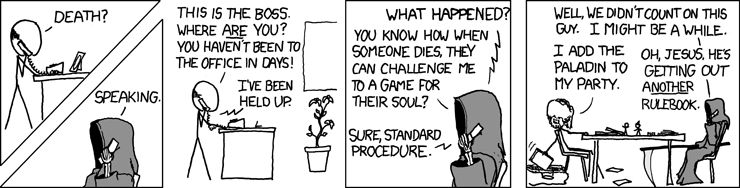
XKCD Tribute to E.G.G.
There's been some posting on alignment going on recently, Eric over at the Tavern, and Talysman at 9 and 30 Kingdoms, have been musing on the subject.  Which made a reader dig up an old post of mine that I had forgotten writing. 
 
Because of that this interesting advice about Chaotic characters caught my eye while researching a future post in Supplement I - Greyhawk from 1976.

"While there is no rule to  apply to groups of chaotic players operating in concert, referees are encouraged to formulate some rules against continuing co-operation as fits their particular situation, but consideration for concerted actions against chaotic players by lawful ones should be given."

Wow, the good guys should gang up and smack down their erstwhile party member(s) before they can backstab them.  This is one page before the paladin is introduced, with the prohibition against associating with Chaotic characters.  "They will associate only with lawful characters."  Emphasis in the original.
Essential he declared open season on any chaotic character, with no side effects even  for paladins.

Alignment in The Big Lebowski
A couple of years later he had switched to the Nine Alignment system. Which for all of the discussions it has spawned over the years, takes up two pages in the DMG and three in the PH (counting the chart as a whole page).  Yet, I've never seen discussion on why the switch was made.

One of the items in the DMG which struck me was the half column on Graphing Alignment.  It is of importance to keep track of player character behavior with respect to their alignment.... It is of utmost importance to keep rigid control of alignment behavior with respect to such characters who serve deities who will accept only certain alignments,...failure to demand strict adherence to alignment behavior is to allow a game abuse.

Wow? E.G.G. is using some pretty emphatic language here and mandating some secret meta-gaming bookkeeping on the part of the DM.  Now there's lots of bookkeeping that the DM and players are mandated to do, in terms of time and light and to some extent encumbrance.  These are all things that affect the characters.  As far as my memory serves, this is the only mechanic that he ever mandates that is aimed at controlling the players.

And it wasn't there in 0e.  It makes me speculate that the Nine Alignments, like the Grappling were someone else' idea that he was talked into.  The game was developed to allow the players to take the part of heroes; villains as said above, were to be ganged up on and defeated, even if they were party members.  However with the introduction of the Assassin as a class, obviously they couldn't be heroes - and in terms of the broader society, Clint Eastwood's anti-hero movies were dominating the decade, at least until the release of Star Wars.  Could that have influenced the change in systems? 


Friday, March 15, 2013

Treasury - Pearl of New Reality

Sometimes a wish is granted or action is taken that changes the course of history ... for awhile.  For the truth is that not all desires can with stand the pressures of Time, Space, Fate and most especially the sheer mass of History, grinding into the future.

When a wish can not stay fulfilled, History, the sages agree, will form an event horizon around the wish and slowly push in until the wish has collapsed into an opalescent  sphere, resembling an extremely large pearl.  Thus encapsulating the altered reality.

After that the sages split into various schools regarding the properties and fate of the orbs.

The Amber school claims if you take one to the space between Shadows it will expand into a whole new reality.

The Alexandrian school claims that the altered reality, complete to the edge of the universe is still within the pearl. And that if you could but pierce the event horizon you could find yourself as you would have been.

The Ankh school agrees with the Amber school, but claims that you have to wait until the end of this reality, when all of the pearls will be able to expand and grow into new realities.

The Rel Astran school says that these are not complete new realities, but seeds of new planes.  The seeds can be "planted" in the Astral plane and nurtured through complex ritual magic to grow into a new plane of existence.

The Chendl school is an offshoot of the Rel Astran and says that the seed must be taken to the Ethereal plane rather than the Astral.

The Waterdeep or Nesting school claims that our reality is contained within a Pearl and that Pearl is itself contained within a series of Pearls all the way back to the Primal Pearl.

The Greyhawk school says that it's a load of ballocks that the Pearls can contain a new reality or plane.  They like to trot out what they say are Xagyg's research notes recovered by a band of intrepid adventurers, which show that he planned to use Pearls to contain the essences of the demi-gods he captured.

The sage Lysixenos, in his scroll On Infinity, relates the apocryphal story that St Cuthbert once offered such a Pearl to Asmodeus, offering to let him escape to found his own reality and never trouble humankind again.  Asmodeus refused with a wry smile, saying "Not again".

Thursday, March 14, 2013

Module Review - BF1 : Morgansfort


  Morgansfort is an introductory module designed for the Basic Fantasy RPG.  I picked up as a freebie from DriveThru RPG.

It's brief introduction gives an overview of "The Western Lands" campaign setting, including major states and a page and a half devoted to the religions of the campaign.  The information on the major states is less than that given in the original World of Greyhawk Gazetteer and only suffices to provide a brief background for the players, including where demi-human PCs may have come from.

The next eleven pages comprise a map and key to the eponymous fortification.  The key includes a more detailed background placing it in the campaign setting and makes it very clear that the setting is a generic medieval society with knights and barons.  The NPC stat lines are as sparse as you would expect from a 1e module, although more background than usual is provided  about the individuals and their unique treasures - should the players embark down the traditional murder hobo route.

After that come "The Old Fortress" the first of three separate dungeons included in the module.  It's a well executed set of lairs inside of an abandoned stronghold.  I like that they provide check boxes for all the monsters HPs, including the random encounters - although I just use scratch paper myself.  For the placed encounters, the writers have included options and tactics for the monsters where appropriate.  The description text for the players is boxed to stand out and brief - readable without needing to paraphrase.The room for the big finale has a standard version and two alternates, changing the monster and treasure.  A very nice touch to allow the DM to run the module more than once or to chose which ever one will mess with his party's minds the most.

The second dungeon "The Nameless Dungeon" has over eighty rooms to explore, more than  three times the size of the first one.  The quality of the work is maintained and they add a unique tapestry and a puzzle that the players need to solve with the help of a handout.  Thoughtfully, they suggest downloading a copy of the PDF, rather than ripping out the page.  You could just scan the page and print it.

The final dungeon is "The Cave of the Unknown" for which the authors provide two pages of background material, which after reading the descriptions, seemed pretty unnecessary; although I'm guilty of publishing the train of thought I used to get to a specific scenario.

This dungeon is even smaller than "The Old Fortress", coming in at just 24 rooms, but does contain an undead spellcaster and a few nasty surprises for an incautious party.  Again the monsters have good tactics and bad guy won't fight to his re-death.

Overall:  A nicely done little booklet.  Getting three dungeons that you can plop into any campaign is good, the quality of the work is excellent even if the creativity isn't of the same standard.


Wednesday, March 13, 2013

Blog Carnival - Epic Moment of GMing


My most memorable time being on the receiving end of an outstanding show of DMsmanship, took place almost thirty years ago.  As I recall, it was Christmastime, I had just gotten married and had flown back up to the Twin Cities to finish the paperwork before going to Naval Officer Candidate School.  Some of the old group were home on leave and a few others hadn't graduated yet.  We decided to get together at the Armory and play Call of Cthulhu.

  I was playing "Moose" a private detective and former lineman with the Duluth Eskimos professional football team.  We were investigating mysterious occurrences at an old house.  I (still do) had a copy of the 1st Edition CoC role playing game and had read a few Lovecraft stories, enough to get a sense that the heroes are usually screwed.

U of MN Armory
As the short winter's afternoon light drained from the windows, the mysterious occurrences kept piling up.  We were charged by a stuffed okapi in a library among other things.  The tension was palpably mounting as we closed in on the source of the trouble, would it be a Deep One or a Polyp or something worse that would mercifully strip our characters of sanity as their flesh was rent asunder and souls blasted forever?

It was a damn leprechaun.  Nothing from the Mythos was involved at all.

What made it epic?  The atmosphere, being pretty much alone in a big masonry castle as the light fades.   The Keeper feeding our suspicions of a horror around the corner and the denouement.  Harris had suckered us in, in a truly epic style.

Submitted for the RPG Blog Alliance March Blog Carnival at Kobold Enterprise.